
A differential pressure switch is widely used in HVAC systems, air handling units, cleanrooms, filter monitoring, fan supervision, and industrial ventilation systems. Unlike a standard pressure switch that responds to pressure at one point, a differential pressure switch compares pressure between two points and changes contact state when the pressure difference reaches a set value.
For OEM buyers and system integrators, understanding the working principle and selection criteria can help avoid unstable operation, false alarms, and incorrect product matching.
A differential pressure switch is a control device that monitors the difference between two pressure points. These two points are usually called the high-pressure side and the low-pressure side. When the difference between them rises above or falls below a set point, the switch activates an electrical contact.
In practical terms, it answers a simple question: “Is the pressure difference between point A and point B within the acceptable range?”
This makes differential pressure switches useful for detecting airflow, filter blockage, fan operation, duct pressure, and pressure balance in controlled environments.
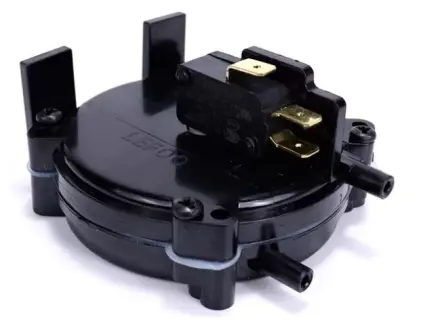
Most differential pressure switches use a diaphragm or similar sensing element. One side of the diaphragm receives pressure from the high-pressure port, while the other side receives pressure from the low-pressure port. When the pressure difference creates enough force, the diaphragm moves and triggers a mechanical switch.
The switch output can then be connected to a controller, alarm, fan control circuit, or building management system.
A typical working sequence is:
The high-pressure and low-pressure ports are connected to two measurement points.
The system starts operating, creating pressure difference.
The diaphragm senses the pressure difference.
When the differential pressure reaches the set point, the contact changes state.
The equipment controller receives the signal and performs the required action.
This structure is simple, but the application design must be correct. Incorrect tube connection, wrong installation position, or unsuitable pressure range can affect switching accuracy.
Differential pressure switches are especially common in air and gas systems. Typical applications include:
| Application | Function |
|---|---|
| Filter monitoring | Detects clogged or dirty filters |
| Fan supervision | Confirms whether airflow or fan pressure is present |
| Air handling units | Monitors duct pressure or airflow status |
| Cleanrooms | Helps monitor pressure difference between rooms |
| Boilers and burners | Supports air pressure or draft safety control |
| HVAC ventilation | Detects abnormal pressure conditions |
| Industrial ducts | Monitors airflow and system resistance |
In filter monitoring, the pressure difference across a filter increases as dust accumulates. A differential pressure switch can signal when the filter needs replacement. In fan supervision, it can confirm whether the fan is generating enough pressure difference to indicate operation.
The most important selection factor is the differential pressure range. A switch with too high a range may not respond accurately in low-pressure HVAC applications. A switch with too low a range may be unsuitable for systems with stronger airflow or higher resistance.
OEM buyers should confirm the following parameters:
Differential pressure range
Set point or adjustable range
Contact type
Electrical rating
Working media
Operating temperature
Pressure connection size
Mounting method
Repeatability requirement
Environmental protection level
Compatibility with control systems
For HVAC applications, low differential pressure sensitivity is often important. For industrial ventilation, durability and stable switching under vibration or dust conditions may be more important.
Some differential pressure switches are factory preset, while others allow field adjustment. The choice depends on the equipment design.
A fixed differential pressure switch is suitable when the OEM has a stable design and wants consistent factory-controlled settings. It can reduce field adjustment errors and simplify installation.
An adjustable differential pressure switch is suitable when the same product may be used in different duct systems, airflow conditions, or filter configurations. It provides flexibility for installers and maintenance teams.
The trade-off is clear: fixed switches support consistency, while adjustable switches support flexibility. OEM buyers should choose according to how the final equipment will be installed and serviced.
Even a correctly selected differential pressure switch may perform poorly if installed incorrectly. Tubing length, tube bending, port orientation, vibration, condensation, and mounting position can all affect the signal.
Important installation points include:
Connect the high-pressure and low-pressure ports correctly.
Avoid blocked, kinked, or leaking tubes.
Keep tubing as short and stable as practical.
Avoid locations with excessive vibration.
Prevent condensation from entering the switch when used in humid air systems.
Mount the switch according to the manufacturer’s instructions.
Confirm the switching point after installation when required.
For cleanrooms and HVAC systems, the measurement points should also be selected carefully. A poor measurement location may produce unstable pressure readings, even if the switch itself is working normally.
One common mistake is selecting a standard pressure switch instead of a differential pressure switch. These two devices are not the same. A standard pressure switch measures pressure relative to a reference point, while a differential pressure switch compares two actual pressure points.
Another mistake is choosing a range that is too broad. If the pressure difference is very small, a broad-range switch may not provide reliable response. For filter monitoring and airflow detection, sensitivity matters.
Buyers should also avoid ignoring the media condition. Differential pressure switches used with air or non-corrosive gas may not be suitable for liquid, oil, or aggressive media unless specifically designed for that use.
For OEM buyers, supplier evaluation should include more than price. A reliable supplier should be able to explain the working pressure range, switching logic, contact form, installation requirements, and application limitations.
When discussing with a supplier, provide:
System type and application
Expected differential pressure range
Media type
Mounting position
Electrical requirements
Set point requirement
Working temperature
Annual demand or project volume
Target market requirements
This helps the supplier recommend a differential pressure switch that matches the real application instead of a generic model.
LEFOO works with pressure control, sensing, and HVAC-related components for OEM and industrial users. For buyers developing HVAC equipment, air handling systems, filter monitoring devices, or ventilation products, LEFOO can support product selection based on operating pressure, switching requirements, installation space, and target application.
Because differential pressure switches are often connected with broader air system control, it is helpful to work with a manufacturer that understands both pressure sensing and equipment-level application needs.
A differential pressure switch monitors the pressure difference between two points and provides a switching signal when the differential pressure reaches a defined value. It is widely used for filter monitoring, fan supervision, HVAC systems, cleanrooms, and industrial ventilation.
For OEM buyers, correct selection depends on pressure range, set point, contact type, media, installation environment, mounting method, and system control requirements. A suitable switch can improve equipment safety, maintenance efficiency, and user experience.
If you are selecting a differential pressure switch for HVAC, ventilation, or industrial equipment, LEFOO can help evaluate your application and recommend a suitable pressure control solution.



 Log in
  English
  日本語
日本語  한국어
한국어  français
  Deutsch
  Español
  italiano
  русский
  português
  العربية