

When designing or maintaining an industrial system, choosing the right pressure control device is essential. Two of the most commonly used components are the pressure sensor and the pressostat (pressure switch). Though they may seem similar at first glance, they serve different functions and are suited for different applications.
In this blog post, we'll explore the differences between pressure sensors and pressostats, their advantages, and how to select the right one for your specific needs. We'll also show how Lefoo's solutions can help improve performance, efficiency, and reliability across various industrial environments.
A pressure sensor is an electronic device that measures pressure and converts it into an analog or digital signal. These sensors provide continuous monitoring and are often integrated into automated systems where real-time data is essential.
Provides continuous pressure readings
Output formats include analog (4–20mA, 0–10V) or digital (RS485, IO-Link)
Suitable for data-driven applications and automated control systems
Typical applications include HVAC systems, pumps, compressors, and industrial process control.
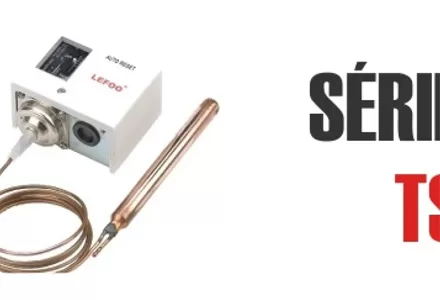
A pressostat, or pressure switch, is a mechanical or electronic device that opens or closes an electrical contact when a specific pressure threshold is reached. It is used for on/off control rather than continuous monitoring.
Operates on set pressure thresholds
Activates or deactivates equipment (e.g., compressors, pumps)
Available in mechanical or electronic versions
Lower cost and simpler to install
Pressostats are ideal for safety cutoffs, basic pressure control, and applications where simple automation is sufficient.
| Feature | Pressure Sensor | Pressostat (Pressure Switch) |
| Output | Continuous signal (analog/digital) | On/off contact |
| Functionality | Monitoring and control | Safety or process switch |
| Accuracy | High | Moderate |
| Integration with Automation | Easy integration with PLCs and SCADA | Limited, suitable for basic systems |
| Cost | Higher | Lower |
| Maintenance Needs | Generally low, depends on electronics | Very low for mechanical models |
Choose a pressure sensor when your application requires:
Real-time monitoring and logging of pressure data
Integration with advanced control systems
High-precision control of process variables
Predictive maintenance and diagnostics
Examples:
HVAC systems with energy management controls
Smart water pump systems
Industrial automation lines
A pressostat is best for applications that need:
Simple pressure-based on/off control
Cost-effective pressure regulation
Basic system protection or interlocks
Examples:
Air compressors
Refrigeration units
Hydraulic presses with safety limits
At Lefoo, we offer both pressure sensors and pressostats, designed for long-term reliability and easy installation across a variety of systems.
High accuracy and stability
Analog and digital outputs
Compact and durable construction
Ideal for HVAC, water systems, and automation
Mechanical or electronic models
Adjustable setpoints
Reliable performance in refrigeration and air systems
Cost-effective and robust
Whether you need precise data monitoring or a simple safety switch, Lefoo provides dependable options to fit your needs.
Before making a decision, consider:
System complexity: Is continuous monitoring needed?
Control requirements: Do you need variable control or just an on/off response?
Budget: Are you optimizing for cost or functionality?
Integration: Does your system use automation or require manual operation?
If you're unsure, Lefoo's technical team is ready to help you evaluate your system and recommend the most suitable solution.
With decades of experience and a commitment to quality, Lefoo offers a complete line of pressure control devices to meet the evolving demands of industrial systems.
Choose wisely. Control precisely. Rely on Lefoo.




 Log in
  English
  日本語
日本語  한국어
한국어  français
  Deutsch
  Español
  italiano
  русский
  português
  العربية