
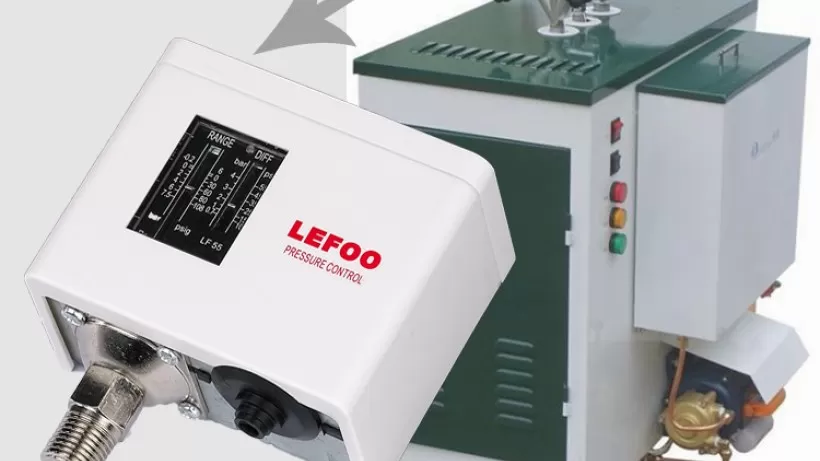
1. What is a pressure switch?
English pressure switch is Pressure switch. Easy to understand explanation, this is a pressure switch. A pressure switch is a form of switch that closes an electrical contact when a certain fluid pressure is reached on its inlet. Switches can be designed to make contact when pressure is increased or decreased. Pressure switches are widely used in industry to automatically monitor and control systems using pressurized fluids.
Another type of pressure switch that detects mechanical force; For example, a pressure sensitive carpet is used to automatically open doors on commercial buildings. Such sensors are also used in security alarm applications such as pressure sensitive floors.
A pressure switch for sensing fluid pressure contains a capsule, bellows, Bourdon tube, diaphragm, or piston element that deforms or displaces proportionally to the applied pressure. The resulting motion is applied, either directly or through amplifying levers, to a set of switch contacts. Since pressure can change slowly and contacts will act quickly, some kind of over-center mechanism such as snap action switch is used to ensure quick operation of the contacts. A type of sensitive pressure switch using a Bourdon tube-mounted mercury switch; Mercury's displacement weight provides a useful central characteristic.
The pressure switch can be adjusted, either by moving the contacts or by adjusting the tension in the counter-spring. Industrial pressure switches may have a calibrated scale and pointer to show the switch's setpoint. A pressure switch will have a hysteresis, i.e. a differential band around its set point, known as the switch dead band, within which small pressure changes have no effect on the state of the contacts. point. Some types allow differential adjustment.
The pressure sensing element of the pressure switch can be arranged to respond to the difference of two pressures. Such switches are useful when the difference is significant, for example, to detect a clogged filter in the water supply system. Switches shall be designed to respond only to differentials and not misbehave to changes in common mode pressure.
Pressure switch contacts can be rated for one-tenth of an ampere to about 15 amperes, with smaller ratings found on more sensitive switches. Usually a pressure switch will operate a relay or other control device, but some types can directly control small electric motors or other loads.
Since the internals of the switch are exposed to the process fluid, they must be chosen to balance strength and life against compatibility with the process fluid. For example, rubber diaphragms are often used when in contact with water, but will rapidly degrade if used in a system containing mineral oil.
Switches designed for use in hazardous areas with flammable gases have an enclosure to prevent arcing at the contacts from igniting the surrounding gas. Switch housings may also be required to be weatherproof, corrosion resistant or submersible.
An electronic pressure switch combines some type of pressure transducer (strain gauge, capacitive element or other) and an internal circuit to compare the measured pressure to a set point. Such devices can provide improved repeatability, accuracy, and precision over a mechanical switch.
2.Types of pressure switches.
Below is a classification of some common pressure switches in practice.
2.1Pneumatic pressure switch (Pneumatic pressure relay)
The specific classification of pressure switches will help to select and use equipment with high accuracy and suitability, saving time and costs. People divide single and dual pressure switches based on the number of sensor signals that can receive signals in the device.
2.1.1Single pressure switch (Single pressure relay)
Compared to other relays, single relays are rated as more durable if made from good materials, anti-corrosion, anti-rust and anti-oxidation such as copper, stainless steel, plastic.
Structure of single pressure switch: LP low pressure setting screw, LP differential setting screw, main arm, main spring, differential spring, expansion box, low pressure connector, contact, terminal screw wire, ground screw, wire entry, flip mechanism for definitive contact opening and closing, locking plate, lever, lug, reset button, for high pressure switch, HP high pressure set screw , high pressure connector.
Low voltage relay
The low-pressure relay is designed to work under evaporating pressure or to trip the compressor circuit when the pressure starts to drop to a level that protects the compressor. In addition, it is also used to adjust the cooling capacity.
Some common low-voltage relay types: pressure relay Danfoss Kp2, Danfoss Kp1, Danfoss 1A...
One thing that needs to be explained to customers is that the contacts of the switch operate at high speed and high voltage. The closing force of the moving contact to the static contact. This is necessary to avoid problems such as fire, contact stickiness, and contact explosion caused by the formation of arcs or sparks when the contacts are opened. For relays, contacts are very important, and arcing is one of the main reasons for contact failure. Since then, problems at the contacts have been reduced, extending the life of the relay.
The time when the driven contact and the static contact meet the end of the circuit is called closing time.
The average closing time of the relay is about one thousandth of a second.
High voltage relay
When the pressure of the condensed water in which the refrigerant flows increases, the high-voltage relay performs the task of opening and closing. When the pressure exceeds the allowable threshold of the air compressor, it stops and compresses the steam.
The working principle of high voltage relay is very similar to that of low voltage relay. However, the arrangement of the contacts will be different.
When the pressure of the compressor increases and exceeds the allowable level, that is, exceeds the value set on the relay, the relay opens the contact and disconnects the circuit of the air compressor. When the pressure is lower than the set pressure minus the differential pressure, the air compressor will resume operation.
High-voltage relays are divided into three types: voltage-limiting high-voltage relays, safety-limiting high-voltage relays, and ordinary high-voltage relays.
2.1.2Dual Pressure Switch (Dual Pressure Relay)
It is called double pressure relay when there is a combination of low pressure relay and high pressure relay. It is combined in a single housing and performs the function of both relays. The dual relay will trip when the pressure exceeds the allowable level and when the pressure drops below the allowable level.
Depending on the model and design, closing can be done manually with the reset lever inside the case or the external reset button.
There is one thing that customers should note when installing this Danfoss dual pressure relay: This type of connection from the suction pipe, the ejector pipe must be in the upper position, helping to prevent oil from falling into the stacking box. Doing this will keep the contacts working properly, the stacking box is not bunched up.
In parallel with the above types, we should not ignore the oil pressure relay to help protect the lubrication of the air compressor in the best way. Because the pressure in the air compressor compartment will change, the inlet oil pressure must be changed.
2.2Hydraulic pressure switch
Oil pressure relay or hydraulic hydraulic pressure switch is a type of relay with up to 3 contacts. There is an oil line designed at the top of the relay, connecting to the system with the oil outlet of the hydraulic pump, an oil extraction line, a pressure adjustment knob.
When the pressure of oil, liquid, water in the system is equal to the pressure set by the operator, the contact will close and the electric motor will stop.
Hydraulic pressure switch has many types divided according to the medium used: oil, water. Water pressure switch prices will vary depending on make, model, size and specifications. Installing a water pressure switch will help protect the pump, protect the water supply system, increase durability, reduce breakdowns and save electricity and water.
hydraulic pressure relay
In addition to the above division, people also divide by origin:
+ Taiwan, Korea
+ Japan, India
+ Germany, China
Or according to the manufacturer, there are different types
+ Pressure switches Danfoss, Honeywell, LEFOO, Saginomiya...
+ Autosigma pressure switch, Sunny...
In addition, we know of special types of switches such as: Ammonia switches are designed with stainless steel, carbon steel to limit the best corrosion. Feon switches can be made of steel or copper alloy.
In order to be able to choose a switch device based on the appropriate pressure signal, parameters such as: pressure threshold, measurement environment, weight, max - min pressure, working temperature ... cannot be ignored. by.



 Log in
  English
  日本語
日本語  한국어
한국어  français
  Deutsch
  Español
  italiano
  русский
  português
  العربية