
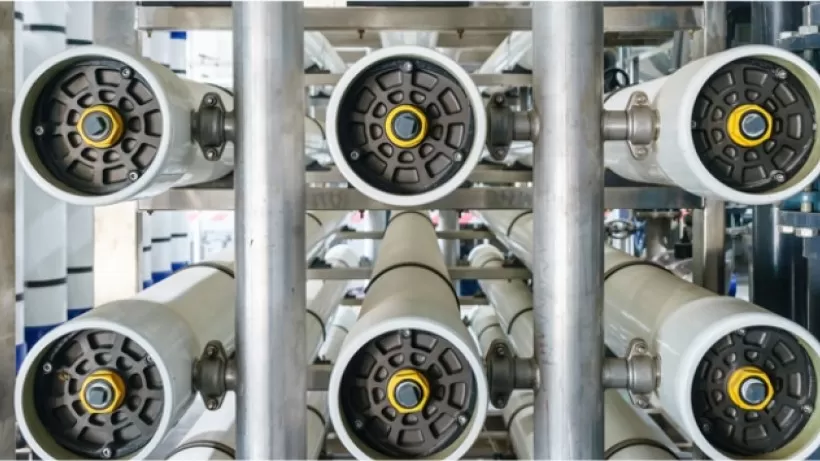
Reverse Osmosis, commonly referred to as RO, is a process in which you demineralize or deionize water by pressing it under a semi-permeable Reverse Osmosis membrane.
To understand the purpose and process of reverse osmosis, you must first understand the natural process of osmosis.
Osmosis is a naturally occurring phenomenon and one of nature's most important processes. It is a process in which a weaker saline solution will tend to migrate to a strong saline solution. Examples of osmosis are when plant roots absorb water from the soil and our kidneys absorb water from the blood.
A less concentrated solution will have a natural tendency to migrate to a solution with a higher concentration. For example, if you had a container full of water with a low salt concentration and another container full of water with a high salt concentration and they were separated by a semi-permeable membrane, the water with the lowest salt concentration would begin to migrate in towards the water container with the highest salt concentration.
A semi-permeable membrane is a membrane that will allow some atoms or molecules to pass, but not others. A simple example is a screen door. It allows air molecules to pass, but they are not pests or anything larger than the holes in the screen door. Another example is the Gore-tex clothing fabric, which contains an extremely thin plastic film, in which billions of small pores have been cut. The pores are large enough to allow water vapor to pass through, but small enough to prevent liquid water from passing through.
Reverse Osmosis is the reverse osmosis process. While osmosis occurs naturally without the necessary energy, to reverse the osmosis process, you need to apply energy to the more saline solution. A reverse osmosis membrane is a semi-permeable membrane that allows water molecules to pass through, but not most dissolved salts, organics, bacteria and pyrogens. However, you need to 'push' water through the reverse osmosis membrane by applying pressure greater than the naturally occurring osmotic pressure to desalinate (demineralize or deionize) the water in the process, allowing pure water to enter while retaining most of the contaminants.




 Log in
  English
  日本語
日本語  한국어
한국어  français
  Deutsch
  Español
  italiano
  русский
  português
  العربية